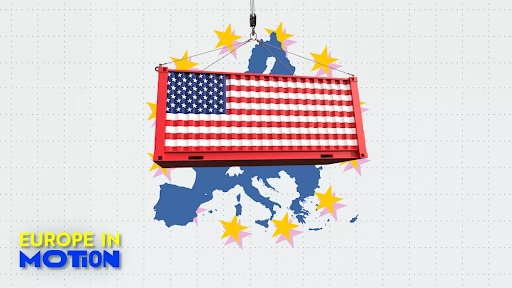

Since beginning his second term a month ago, U.S. President Donald J. Trump has announced, imposed, and floated a raft of trade policies that have threatened previously strong relationships with countries allied to the United States, economically and otherwise. Chief among these fairly unprecedented—but not particularly unexpected—measures was the announcement of “a 25% additional tariff on imports from Canada and Mexico and a 10% additional tariff on imports from China,” with “a lower 10% tariff” on imports of Canadian energy resources. These tariffs were a direct response to what the Administration described as the “extraordinary threat posed by illegal aliens and drugs, including deadly fentanyl,” which they argue “constitute(d) a national emergency under the International Emergency Economic Powers Act (IEEPA).”. Canada and Mexico, the U.S.’s two largest trading partners, were denounced to hold them accountable “to their promises of halting illegal immigration”, whereas China was sanctioned for their alleged role in the supply of fentanyl to the U.S.

Canadian Prime Minister Justin Trudeau (left) and Mexican President Claudia Sheinbaum (right) talking at the G20 Brazil Summit in November 2024—both leaders came out swinging against Trump’s proposed tariffs, which he eventually stood down on (photo from The Hill)
Hours later, warnings of strong retaliatory tariffs were issued by Mexican President Claudia Sheinbaum and Canadian Prime Minister Justin Trudeau, with the latter’s measures including a similar 25% levy on CAD$155 billion (€104 billion) in American goods. This back-and-forth action between the North American trifecta sparked immediate fears of a trade war, with the European Union (EU) urging de-escalation between the parties involved. Shortly after this, however, the tariffs were postponed by 30 days, as Prime Minister Trudeau announced the progress sparked by a “good call” with President Trump, which would include the continued implementation of a CAD$1.3 billion (€870 million) border plan, as well as the appointment of a fentanyl czar’ and the deployment of a “Canada-U.S. Joint Strike Force to combat organized crime.”. Mexico, likewise, made some commitments that resulted in their sanctions being halted as well.
Elsewhere, President Trump has restored and revamped the previously existing ‘Section 232‘ tariffs’—originally imposed by his first administration in 2018—that concern steel and aluminum imports, both of which will now be levied at 25%. This action was taken by the Trump administration to “end unfair trade practices and the global dumping of steel and aluminum,” as well as “strengthen (the) United States’ steel and aluminum industries.”. More recently still, Trump has announced the imminent imposition of tariffs on automobiles “in the neighborhood of 25%” along with levies on semiconductors and pharmaceutical imports in the same range, which will “go very substantially higher over a year,” tariffs which are scheduled to be formally rolled out at the start of April.

In October 2024, Trump stated to the Economic Club in Chicago that ‘tariffs’ was his “favorite word,” a clear precursor to what was to follow in the early weeks of his presidency. (Photo from NPR Illinois)
While this tariff frenzy may have caught some by surprise, particularly given the speed and volume of action being taken, one need not look further than Trump’s 2024 campaign for early hints of what was to come. Having previously labeled himself as a “Tariff Man” in 2018, Trump last year went a step further, citing ‘tariffs’ as “the world’s most beautiful word in the dictionary.”. Of the term, Trump said, “It’s my favorite word. It needs a public relations firm,” adding in what was assumed to be a joking manner, “If I’m going to be president of this country, I’m going to put a 100, 200, or 2,000% tariff. They’re not going to sell one car in the United States.”
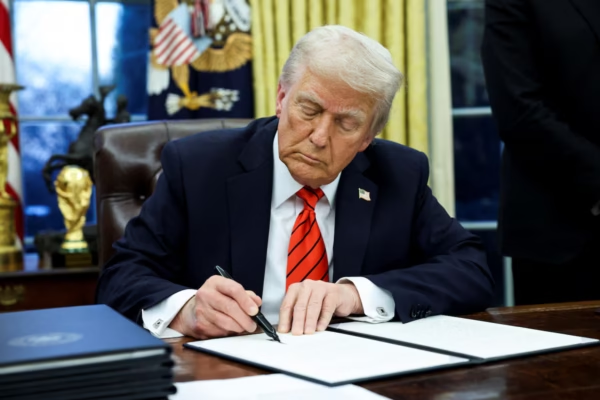
Featured image: U.S President Donald J. Trump signing an Executive Order in the White House’s Oval Office (Photo from Reuters)