

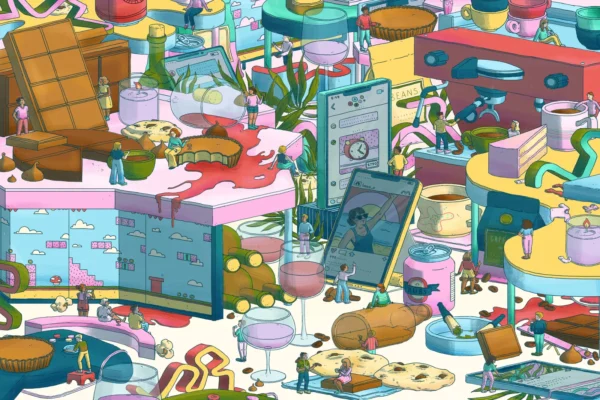
Are you addicted? I know I am, and chances are, you are too.
But if it helps, you can always tell yourself that your addiction is ‘better’ than someone else’s. Or perhaps you go a step further and deny the notion of addiction altogether – whatever makes you sleep better at night.
You’re not a nicotine addict? Then, you’re probably a caffeine addict. No? Well, maybe it’s sugar, or that constant need to check your phone every 5 minutes. Still not hitting home? Then maybe it’s your endless pursuit of productivity, validation, or even perfection.
Don’t worry, It’s not just a coincidence. The economy is addicted to you, too. David Courtwright puts it as Limbic Capitalism– a technologically advanced, yet socially regressive business model where industries encourage excessive consumption and addiction. This system relies on brain-rewarding, non-durable goods. Once it’s gone, you’re already thinking about your next time.
Picture this: you walk into your favourite café, the one you discovered from a random TikTok of a girl’s ‘day in the life.’ You grab an iced coffee, and maybe later even treat yourself to a second one,because, well, it’s been a tough day. The next day, you find yourself back for another. That is, unless they ran out of flat lids, because dome lids just aren’t aesthetic enough to keep that addiction going. From the design of the cup to the ambiance of the café, it was all made to make sure you come again.
The modern economy thrives on dopamine. Happy consumers are loyal consumers.
It’s a loop. You get a notification. You endlessly scroll through your TikTok for-you page. You come across a new place that opened. You visit it, and soon enough, you’re posting about it yourself, waiting for that stream of likes to roll in. You suddenly find yourself in a reinforcing cycle of consumption and validation.
The modern economy thrives on dopamine. Happy consumers are loyal consumers. Dopamine is the chemical that triggers pleasant feelings when released, and our brain’s reward system forms strong associations between the action and the satisfaction that follows. Every time you go buy that coffee, or check your phone to find a notification, your brain reinforces this link. Over time, this cycle becomes harder to break. Rather than enjoying the momentary buzz, you start chasing the next hit of dopamine. In the age of abundance and overconsumption, dopamine-triggering stimuli have become easily accessible– to eventually become your norm. When an addiction stops bringing you pleasure and only makes you feel ‘normal,’ that’s when you realise that it’s become a problem. This isn’t just your problem; it’s the problem of the modern economy. Businesses have mastered the art of keeping this cycle alive, making sure you always come back for more.
So, who’s to blame? Is it the addict or the “addicter”, who creates and sustains such enticing environments? Where do we draw the line between ethical and unethical marketing, between simply promoting a product and exploiting psychological behavioural patterns?
Awareness is control. Hold on to your consumer power. Don’t be a passive consumer of the modern economy – understand how you’re being nudged. Rewire your brain by reclaiming your natural sources of dopamine and stepping away from the instant gratification that the modern economy promises. Find your true happiness.
Featured image by NPR.
Views of this article


When was the last time you stopped to wonder if something you wore, said, or did might offend someone from